The Urysohn lemma
Define by
It is a fact that is . This is proved by showing that for each there is a polynomial of degree such that for , and that , which together imply that .
Define by
Because is , the chain rule tells us that is .
For a function on and for , we define
We now construct bump functions.11 1 The following construction of a bump function follows Gerald B. Folland, Real Analysis: Modern Techniques and Their Applications, second ed., p. 245, Lemma 8.18.
Theorem 1 ( Urysohn lemma).
If is a compact subset of and is an open set containing , then there exists with , on , and . Moreover, if is invariant under then the function constructed here is radial.
Proof.
Let
which is positive because is compact and is closed. Let
and define on by
whose support is
Finally define on by
Because is bounded and is , the function is . The support of is
Because and are nonnegative, so is their convolution . For any ,
so . For , if then . But for , so in this case . This implies that for the functions and are equal, hence
This shows that on , verifying all the assertions made about .
The function is radial and so is too. If is invariant under , then the indicator function is radial. Thus, if is invariant under then is radial, and the convolution of two radial functions is also radial, which means that is radial in this case. ∎
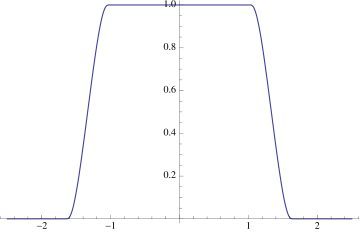
For example, take , take to be the closed ball of radius , and take to be the open ball of radius . Then and . In Figure 1 we plot the bump function constructed in the above theorem.