Some fundamental results on modular forms
1 Introduction
The purpose of this paper is to give complete proofs to several fundamental results about modular forms. Modular forms are complex functions with certain analytic properties, and that transform nicely under a certain group of transformations of the complex upper half plane. It turns out that modular forms can be used to study analytic number theory, by investigating the coefficients in series expansions of the modular forms. In fact, often using modular forms we can discover and prove things in number theory where a direct proof might not be obvious. To help the reader get a feel for this, we will give an example; all the terms used here are defined in the paper. An important class of modular forms, called Eisenstein series, have expansions that involve the divisor sum . Another modular form, called the modular discriminant, has a series expansion that involves the Ramanujan tau function, . Modular forms comprise vector spaces whose dimensions we can explicitly determine. Using this information one can prove the congruence
We will develop all the results needed to prove this congruence and other similar results (cf. [9]).
We have tried to find the clearest proofs in the literature for the results about modular forms in this paper. The proofs use complex analysis and group theory, and do not assume advanced results.
In §2 we introduce a group action on the complex upper half plane, under which modular forms are well behaved.
Next in §3 we define modular forms and cusp forms, which are defined on the upper half plane. We show that modular forms have Fourier expansions. Indeed it is often convenient to study a modular form through its Fourier series. We also show that modular forms constitute complex vector spaces. We explicitly construct a class of modular forms, namely the Eisenstein series, in §4. However, these are not cusp forms. In §5 we construct a cusp form of weight 12, and prove estimates on the magnitude of the Fourier coefficients of cusp forms.
Finally in §6 we give a formula for the dimensions of spaces of modular forms. We also introduce a natural inner product on the spaces of cusp forms.
We will now introduce some notation that will be used throughout this paper. Let be the integers, be the complex numbers, be the real numbers, and , . For a commutative ring with unity 1, let be the group of all matrices over with determinant 1. For integers not both , let denote their greatest common divisor.
2 Automorphisms of the complex upper half plane
Let be the complex upper half plane. Modular forms are defined on the upper half plane, and transform nicely under a certain group that acts on . We will present this group now, and prove several properties about it.
is called the modular group.
Lemma 1.
has an action on defined by for and .
Proof.
If and , then
Therefore .
Let and let . Then
As well, for all , . Hence the identity element of fixes all . ∎
The proof of the following theorem follows [2, Chapter I, 5.7].
Theorem 2.
is generated by and .
Proof.
Let . We may assume that since is generated by and if and only if is. If , then , and so or . In the first case, , and in the second case, .
We now assume that for , and all the element is generated by and . Because is generated by and if and only if is, we may assume that . For , let be an integer such that . By the induction hypothesis,
is generated by and . Thus is generated by and . ∎
Two points are said to be equivalent under if there exists an such that . A subset of is said to be a fundamental domain for if it is an open connected set (i.e. a domain) such that no two distinct points of are equivalent, and every point of is equivalent to some point in , the closure of . In the following theorem we explicitly give a fundamental domain for . Our proof follows [8, Chapter VII, Theorem 1].
Theorem 3.
is a fundamental domain for .
Proof.
Let and let such that . We will show that and thus that . This implies that no two distinct points of are equivalent. If , then . But , and if and only if ; hence we may assume that . Then , so, since , must either be or . If then and is translation by . But , so must be , otherwise . In this case indeed .
If , then for . Then . As , it follows that . In this inequality cannot be 0, so we can divide by . If then , a contradiction since , and if then , again a contradiction since . Hence, the case does not occur. If , we can replace with (since if and only if ), and the above argument shows that the case does not occur, and thus the case does not occur. Therefore if and such that , then .
Now, let . Now, for a given , there are only finitely many integers such that . Hence there is a such that
is maximal. We may choose to be an integer such that . Put . If then would have an imaginary part strictly greater than , a contradiction. Thus , and . This proves that every point in is equivalent to some point in the closure of . ∎
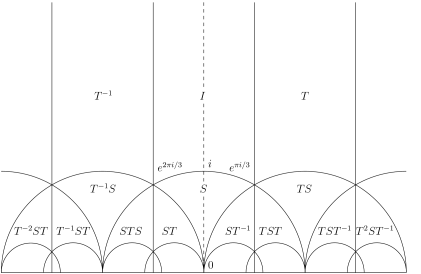
The fact that is a fundamental domain for will be used in §6. The images of under several elements of are shown in Figure 1.
If is identified with the mapping , then is the automorphism group of the upper half plane (i.e., the group of all holomorphic bijections , cf. [5, Chapter VII, §3]). In the next section we define modular forms, which are “almost” invariant under automorphisms of the upper half plane.
3 Modular forms and cusp froms
In this section we define modular forms. We prove that they have Fourier expansions. Then we define cusp forms, which are an important class of modular forms, with constant term in their Fourier expansions. We then show that modular forms and cusp forms constitute vector spaces, and prove a result about pointwise products of modular forms.
We define the factor of automorphy by for and .
A holomorphic function is said to be holomorphic at infinity if exists.
Definition 4.
For , a modular form of weight , with respect to , is a function that is holomorphic on , holomorphic at infinity, and satisfies
for all . The set of all modular forms of weight is denoted by .
Fourier series will be important in studying modular forms and cusp forms, so we first introduce these. We say that a function is -periodic if for all .
Lemma 5.
If is holomorphic and -periodic, then has an expansion
| (1) |
valid for all .
Proof.
Let be the annulus obtained by removing the origin from the unit disc. We define by for all . Indeed, if , then for some integer and . Hence by periodicity. Thus is well defined.
For all , there exists a holomorphic branch of the logarithm, say , defined in some neighborhood of . Then for all , . Thus on , is the composition of holomorphic functions. Hence is holomorphic at . Therefore is holomorphic on .
Since is holomorphic on the annulus , it has a Laurent expansion
| (2) |
valid for all [5, Chapter V, Theorem 2.1], and
with , as desired. ∎
The expansion (1) is called the Fourier expansion or -expansion of the function .
Since , for , then for all , i.e. is 1-periodic. Thus by Lemma 5, modular forms have Fourier expansions. Let and let , . There is an such that . Let be given. Then there is a such that for all , . Let . Say is such that . Now, for some . Then . As is an increasing function on , this implies . Hence , and so . Thus . Hence is bounded in a neighborhood of , so for all in its Laurent expansion (1). This means that for all in the Fourier expansion (1) of a modular form.
We recall [5, Chapter V, Theorem 2.1] that for , the Laurent series in (2) converges absolutely for such that . Thus in particular the Laurent series converges absolutely for . This shows that the Fourier series (1) converges absolutely for . Now, let ; it is clear that has a maximum value on . We define for . That the Fourier series (1) converges absolutely for means that converges. But for all . Therefore by the Weierstrass -test, the Fourier series (1) converges uniformly on . However, if a sequence converges uniformly on a set and is a limit point of , then [6, Theorem 7.11]. Thus,
| (3) |
This tells us that constant term in the Fourier series of a modular form is the limit of the function at .
We will often need to consider modular forms with constant term in their Fourier expansions. Thus we make the following definition.
Definition 6.
A cusp form of weight is a modular form of weight whose Fourier expansion has a 0 constant term, i.e. and
The set of all cusp forms of weight is denoted by .
From (3), a modular form is a cusp form if and only if .
Suppose is odd and . Let . Then for all ,
so is the zero function on . Thus for all odd , contains only the zero function.
In the following theorem we show that the modular forms of weight form a complex vector space, and that the cusp forms of weight are a subspace.
Theorem 7.
For every integer, is a complex vector space and is a subspace of .
Proof.
Let and . Since and are holomorphic on , is holomorphic on , and since and exist, exists. Therefore is holomorphic at infinity. For and ,
hence satisfies the automorphy condition. Thus . This proves that is a complex vector space. If , then , and thus . Hence is a subspace of . ∎
For modular forms and , we shall define their product by . The next lemma shows that the product of a modular form of weight and a modular form of weight is a modular form of weight . We will use this result later in §6.
Lemma 8.
If and , then .
Proof.
It is immediate that is holomorphic on and holomorphic at infinity. Let and . Then
showing that satisfies the automorphy condition. Therefore is a modular form of weight . ∎
4 Eisenstein series
Now we will explicitly construct a class of modular forms of all even weights , the Eisenstein series of weight . In particular these will not be the zero function, thus giving us nontrivial examples of modular forms. Moreover, these are not cusp forms. In fact, we will show later in this section that for even , any modular form of weight is a linear combination of an Eisenstein series of weight and a cusp form of weight .
Definition 9.
The Eisenstein series of weight is defined by
for , where the primed summation means that summation is over all such that .
In the following theorem we prove that for all even , the Eisenstein series is a nonzero modular form of weight . This will be our first example of a modular form (aside from the zero function). The proof follows [7, Theorem 1, Chapter III].
Theorem 10.
For all even integers , the Eisenstein series is a modular form of weight .
Proof.
We will use the fact [5, Chapter V, §1] that the series defining the Riemann zeta function converges absolutely for . First we show that the series defines a holomorphic function . Let be a compact subset of . Let be the unit circle in . Recall that is a compact subset of . Thus the product is a compact subset of . Clearly, is a continuous function . Hence it attains a minimum value . For all and with ,
Thus for all , is bounded above by the series
Now,
where the inner summation is over those such that and , or and . Fixing , there are a most such pairs . Thus
We have shown that is an upper bound for . Since , the latter series converges, so by the Weierstrass -test, converges uniformly (and absolutely) on .
This proves that converges uniformly on compact subsets of . Therefore according to [5, Theorem 1.1, Chapter V], is a holomorphic function on .
We now show that satisfies the automorphy condition. Let and . Then
| (4) | |||||
Since , is a bijection , by the Euclidean algorithm [3, §12.3]. Thus, after changing variables,
| (5) |
Finally we show that is holomorphic at infinity. For and , we have . But since satisfies the automorphy condition, then , and so . That is, is 1-period. Since is holomorphic on with period 1, by Lemma 5 it has a Fourier expansion
Now, since is even and converges absolutely,
For , the inner series is . It follows from the Weierstrass -test that the series and converge uniformly on every compact subset of and hence define holomorphic functions on . Therefore defines a holomorphic function on . Certainly is 1-periodic. Thus it has a Fourier expansion
Then by Laurent’s formula [5, Chapter V, Theorem 2.1], for an arbitrary ,
Since is even and , the series converges uniformly so we can interchange integration and summation
| (6) | |||||
where .
Put . Thus
This integral converges to some since . Thus
Since we can choose to be arbitrarily large, it follows that
For , we integrate along the oriented paths in Figure 2, where is arbitrary, and apply the residue formula [5, Theorem 1.2, Chapter VI] to obtain
| (7) |
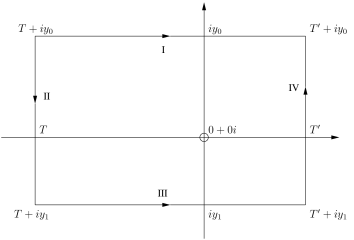
On path II,
That is, an upper bound for on path II is . The length of path II is . Thus by [5, Theorem 2.3, Chapter III] we have the estimate
The limit of the righthand side of this inequality as is 0. Hence .
Similarly on path IV,
The length of path IV is , so we have the estimate
Hence .
For path III,
hence
However, [5, Chapter XV, §2, K7]. Thus the absolute value of the above integral is bounded above by .
Since is arbitrary, it must be that
Therefore (7) reduces to
Now, the Laurent series of is
Thus . Hence
By (6) we have
giving us the Fourier series when .
Then for ,
hence
| (8) | |||||
where is the sum of the th powers of the positive divisors of , e.g. .
Therefore . Hence is holomorphic at infinity, and the constant term in the Fourier expansion of is . Since , is not the zero function. ∎
For even , in the following theorem we show that decomposes into an internal direct sum of the cusp forms and multiples of the Eisenstein series .
Theorem 11.
For all even ,
Proof.
For , has a Fourier expansion
Let . Then , and where . Furthermore, the only multiple of with zero constant term in its Fourier expansion is the zero function. Hence the intersection of and is the zero subspace of . Thus . ∎
5 The Dedekind eta function
We would like to give an explicit example of a nonzero cusp form. We will construct this using the following function.
Definition 12.
The Dedekind eta function is defined by
| (9) |
for .
We will now show that the Dedekind eta function is holomorphic on and has no zeros in . This will be done by showing that the infinite product defining converges uniformly on all compact subsets of . We will prove the uniform convergence of this infinite product by results about the uniform convergence of series.
Let be a sequence of complex numbers such that the series converges. Here for (the open unit disc with center ). For all , . Since the exponential function is continuous, we have .
Let be a compact subset of . Let such that is maximum, and put . Since , there is some such that for all , . Now, let , and put . For all ,
But the series converges (since ). Hence by the Weierstrass -test, converges uniformly on .
Let be a sequence of continuous functions that converge uniformly on to a (continuous) function . Then there exists an such that for all , for all . Since is continuous, is compact, hence it is contained in a closed disc, of radius . Let be the closed concentric disc with radius . Then for all . Now let be given. Since is continuous on the compact set , it is uniformly continuous on [6, Theorem 4.19]. Hence there exists a such that if and , then . But since uniformly on , there exists an such that for all , for all . So for all . Thus converges uniformly on to . Setting , we find that the infinite product converges uniformly on .
Since the infinite product converges uniformly on all compact subsets of , is a holomorphic function [5, Chapter V, Theorem 1.1]. As for all , for all .
The following theorem shows how transforms under , one of the two generators of the modular group , by Theorem 2. After this theorem, we can then show how transforms under the whole modular group . Our proof of the following theorem follows [2, Theorem 2, Chapter VIII].
Theorem 13.
For all ,
where is the principal branch of the square root, holomorphic on the plane with the ray removed.
Proof.
and are holomorphic functions of on . If they are equal on a set with an accumulation point in then they are equal on all of by the identity theorem for holomorphic functions [5, Chapter III, Theorem 1.2]. It therefore suffices to prove the theorem for purely imaginary . Suppose now that .
Since for , we can take logarithms in (9), and use the series expansion
to obtain
| (10) |
The double series converges absolutely, because .
Since , we have . We can therefore replace with in (10) to obtain
| (11) |
Since
to prove to the theorem it suffices, by (10) and (11), to prove
| (12) |
Now, the th partial sum of the infinite series in (12) can be written as
| (13) |
where is the cotangent function.
To prove the theorem, by (13) it suffices to prove that
| (14) |
This will be done by applying the residue theorem to a certain path integral, of a suitably chosen function.
Let
| (15) |
Since has a simple zero at and no other zeros, and has a simple zero at and no other zeros, , the function has a simple zero at and a simple pole at , , and no other zeros or poles. Therefore is meromorphic, with simple poles at and , where is any nonzero integer, and a triple pole at , and has no other poles.
The Laurent expansion of about is found by noting that
and so
Furthermore, has period , because
Thus the Laurent series of about is
and the Laurent series of about is
The residues of at , , and are respectively
i.e.
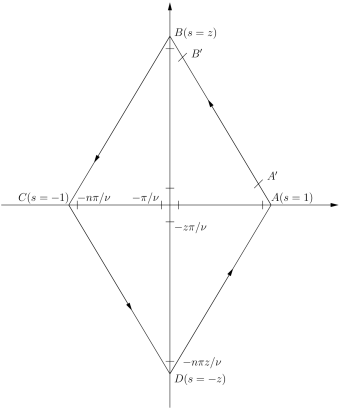
Let denote the parallelogram with vertices at , , and oriented counterclockwise, shown in Figure 3. Then since , the residue theorem implies that
Here the initial term is the residue of at the triple pole , and the summation is over the residues of at the simple poles and respectively; the function has no other poles inside . Thus,
To prove (14) it therefore suffices to prove that
| (16) |
Because has period , and for with , (since the only pole of with real part between and is ), it follows that
| (17) |
Here is independent of and . As well, since
we have
| (18) |
Let be a compact subset of the upper half plane , and let . As , for . Thus by (18), as uniformly for (since as is compact, there is an such that is minimum). Similarly, as uniformly in every compact set in the lower half plane , as uniformly in every compact set in the left half plane , and as uniformly in every compact set in the right half plane .
To prove (16), we shall show that
| (19) |
where the integrals on the right hand side are along the respective paths , , , of the parallelogram . We will then show that the sum of the integrals on the right hand side is equal to , which would prove (16).
We first split the integral along the path into three parts, from to , to , and to , such that the distances and are equal to , to be chosen sufficiently small. From above, uniformly as , for in the compact set . Therefore, for any there exists a such that for all , for . But has a minimum on , so for . By (17), for all . Hence, given , there exist a and a such that for all , we have
We have just shown that
| (20) |
Similar results hold for the other three edges of . Thus (19) follows, and
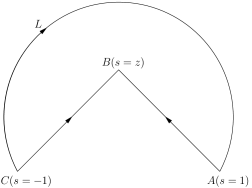
Let be a simple curve in the upper half plane joining and and not passing through or , as in Figure 4. Since is homotopic to the arc of the unit circle from to , which is parameterized by , by [5, Chapter III, Theorem 5.1] we have
As is not in the region contained by and the line segments , by the residue theorem we have
This proves (16), and thus the theorem. ∎
The proof of the analog of the automorphy condition for follows [2, Chapter VIII, Theorem 3].
Theorem 14.
Suppose are integers such that . Then for all ,
| (21) |
where is a th root of unity that depends on , but not on .
Proof.
First we note that for all ,
| (22) |
Let , and let . If or then
| (23) |
holds because of (22) and Theorem 13 respectively. Now suppose (23) holds for some fixed . Then
and
Hence
by (22). Therefore so (23) holds for . Furthermore
by Theorem 13. Therefore (23) holds for . Since is generated by and , by Theorem 2, therefore (23) holds for all .
For , taking the 24th roots of both sides of (23) gives for some function that takes values in the 24th roots of unity. But and are continuous functions of on , and for all , so is a continuous function on . Since is a continuous function from the connected set to the discrete set of th roots of unity, it must be a constant th root of unity , which completes the proof. ∎
Now we can explicitly construct a cusp form. By taking the 24th powers of each side of (21) we find that satisfies the automorphy condition for all and . This leads us to define the following function.
Definition 15.
The modular discriminant is defined by
for .
Corollary 16.
The modular discriminant is a cusp form of weight 12.
Proof.
That is a holomorphic function and that is holomorphic at infinity follows immediately from .
Suppose such that . Then for , Theorem 14 tells us that
This shows that satisfies the automorphy condition. Therefore is a modular form of weight 12.
Moreover,
showing that is a cusp form of weight 12. ∎
Since is a cusp form, it has a Fourier expansion , . The Ramanujan tau function is defined by for all , that is, the Ramanujan tau function is defined by the Fourier coefficients of the modular discriminant.
We give the following estimates for the magnitude of the Fourier coefficients of cusp forms. The following estimates will be employed in defining a certain inner product on in §6. Moreover, since the Fourier coefficients of cusp forms are related to number theoretic functions, estimates on their magnitude give us number theoretic information. The proof of the following theorem follows [8, Chapter VII, Theorem 5].
Theorem 17.
If with Fourier expansion
then for all .
Proof.
Indeed the series defines a holomorphic function in a closed disc about of radius for any . Let such an be fixed. Then has a maximum value in the compact set . Hence for , as ,
since for all sufficiently large , . Let for . Then for all , . Hence
so is invariant under . Since is a cusp form, as . Since is continuous on , the closure of the fundamental domain , it is bounded on the compact set obtained by removing all with some . Therefore for some , for all . The invariance of under implies that for all . Hence
| (24) |
6 The vector spaces of modular forms
In this section we will prove several results about the vector space , and in particular the subspace . We will explicitly determine the dimension of . After this we will introduce an inner product on the subspace of cusp forms .
For modular forms where has no zeros in , we shall define their quotient by . Let be the order of the zero at infinity.
Lemma 18.
If such that has no zeros in and , then .
Proof.
Clearly is holomorphic on . Since , is holomorphic at infinity.
Let , and let . Then
which shows that . ∎
The following lemma shows that a modular form of weight 0 is constant. This lemma will be used in determining the dimension of , for which we need to show that certain modular forms must be scalar multiples of other modular forms. Our proof of this lemma follows [4, Chapter IX, Notes on §9.11].
Lemma 19.
A modular form of weight is constant.
Proof.
Let be a modular form of weight . Let , a fundamental domain for . Then for , for some . Since is also a modular form of weight , we may suppose without loss of generality that .
Because for , , there is a such that for all with , . Then in the compact set , is bounded. Hence is bounded on .
Let . If , then there exists a such that for all with , . Thus attains its maximum in . By the maximum modulus principle [5, Theorem 1.3, Chapter III], attains its maximum at some on the boundary of , so . If is not constant then there must be a such that . But since is a fundamental domain for , there exists a such that . As is a modular form of weight , , a contradiction. Thus is constant. ∎
It will be convenient to define the normalized Eisenstein series by
where is the Riemann zeta function. Certainly is a modular form of weight , since is. Thus has a Fourier series . We will use the fact that and , which are immediate from the Fourier series (8) of . In particular, since and [8, Proposition 7, Chapter VII], the coefficient of in the Fourier expansions of and is respectively and .
The proof of the following theorem follows [1, Proposition 1.3.3]. It will be used in the proof of the general formula for the dimension of .
Theorem 20.
The space of cusp forms of weight 12 is one dimensional, spanned by the modular discriminant . Moreover,
| (25) |
Proof.
Let . has no zeros in and . By Lemma 18, is a modular form of weight . Thus is a constant, so for some .
We work out the first several terms of the Fourier expansion of to find
This implies that is a cusp form of weight 12, and by the above, for some constant . Thus comparing the Fourier coefficients of , we see that , completing the proof. ∎
The proof of the following fact follows the sketch [1, Exercise 1.3.3]. A consequence is that for , which we will use in our proof of the dimension formula for .
Lemma 21.
Let . If does not divide , then for any modular form of weight .
Proof.
, and
Certainly then . On the other hand, as is a modular form of weight , . Since ,
But is not a multiple of 3, so it must be that . ∎
Now we can determine the dimension of . Our proof of the following theorem follows [1, Proposition 1.3.4].
Theorem 22.
If is an even nonnegative integer with for , then
Proof.
We will first show that for or , is the zero space and thus that is generated by . Let , and suppose by contradiction that is not the zero function. Now, for , is a modular form of weight 0 by Lemma 18. Hence it is a constant . So . This implies that has no zeros in , because has no zeros in and is holomorphic in . For , or . We consider . Since has no zeros in and does not have a zero at infinity, it follows that is a modular form of weight . has a zero of order at infinity but is not the zero function, a contradiction. This means that must be the zero function. Hence for or , is spanned by the Eisenstein series and thus is one dimensional.
We now show that is the zero space. Suppose by contradiction that is a nonzero element of . Then . From the above, we know that is generated by , hence for some . Because is not the zero function, . By Lemma 21, for . This implies that , as . But then by (25), , which is a contradiction. Therefore must be the zero function. So is the zero space. Finally, is of course one dimensional, as it spanned by any constant nonzero function .
For , we shall show that is a vector space isomorphism . Clearly this mapping is linear over . If is the zero function then must be the zero function (since has no zeros in ), so this mapping is injective. If , then is a modular form of weight . However, is sent by this mapping to . This shows that this mapping is a surjection. Therefore the vector spaces and are isomorphic, and thus have the same dimension. ∎
We now introduce an inner product on the space of cusp forms of a given weight . We will show that indeed is an inner product, that is, that it is linear in the first argument, conjugate symmetric, and positive definite.
Definition 23.
The Petersson inner product on is defined, for , by
| (26) |
where .
Theorem 24.
is an inner product on .
Proof.
By (24), , i.e., there exist such that for all sufficiently large , . Then, since ,
Therefore the integral (26) converges. We shall now show that is an inner product on .
That for all , follows immediately from the fact that integration is linear.
Let . Then
showing that is conjugate symmetric.
Let . If on then . Otherwise, if is not identically 0 on , then there is some such that . Since is a fundamental domain, there exist such that . Because , then . Since is continuous, there is some disc of radius about on which is nonzero. But indeed there is a disc of radius such that . Hence,
so if . This verifies that is positive definite. Therefore is an inner product on . ∎
References
- [1] (1997) Automorphic forms and representations. Cambridge Studies in Advanced Mathematics, Vol. 55, Cambridge University Press, Cambridge. External Links: ISBN 0-521-55098-X, MathReview (Solomon Friedberg) Cited by: §6, §6, §6.
- [2] (1985) Elliptic functions. Grundlehren der Mathematischen Wissenschaften [Fundamental Principles of Mathematical Sciences], Vol. 281, Springer-Verlag, Berlin. External Links: ISBN 3-540-15295-4, MathReview (Marvin I. Knopp) Cited by: §2, §5, §5.
- [3] (1979) An introduction to the theory of numbers. Fifth edition, The Clarendon Press Oxford University Press, New York. External Links: ISBN 0-19-853170-2; 0-19-853171-0, MathReview (T. M. Apostol) Cited by: §4.
- [4] (1959) Ramanujan: twelve lectures on subjects suggested by his life and work.. Chelsea Publishing Company, New York. Cited by: §6.
- [5] (1999) Complex analysis. Fourth edition, Graduate Texts in Mathematics, Vol. 103, Springer-Verlag, New York. External Links: ISBN 0-387-98592-1 Cited by: §2, §3, §3, §4, §4, §4, §4, §4, §4, §5, §5, §5, §5, §6.
- [6] (1976) Principles of mathematical analysis. Third edition, McGraw-Hill Book Co., New York. Note: International Series in Pure and Applied Mathematics Cited by: §3, §5.
- [7] (1974) Elliptic modular functions: an introduction. Springer-Verlag, New York. Note: Translated from the German by J. R. Smart and E. A. Schwandt, Die Grundlehren der mathematischen Wissenschaften, Band 203 External Links: MathReview (W. W. Stothers) Cited by: §4.
- [8] (1973) A course in arithmetic. Springer-Verlag, New York. Note: Translated from the French, Graduate Texts in Mathematics, No. 7 Cited by: §2, §5, §6.
- [9] (1988) Congruence properties of . In Ramanujan revisited (Urbana-Champaign, Ill., 1987), pp. 289–311. External Links: MathReview (M. Ram Murty) Cited by: §1.